Wednesday, December 21, 2011

In memoriam: Prof. Marci Campbell

Early this week I received notification of the terrible news that Prof. Marci Campbell, professor at the department of nutrition at the UNC School of Global Public Health of the University of North Carolina at Chapell hill died of cancer.
Dr. Campbell’s research focused on nutrition behavior change for health promotion and disease prevention. Her research focused on investigating health communication strategies aimed at reducing risk factors for cancer and chronic diseases in minority and under-served communities. Approaches include testing effectiveness and cost-effectiveness of computer-generated, individually tailored interventions on diet, physical activity, and cancer screening behaviors for health promotion and disease prevention in diverse populations; impact of multi-level interventions including individual, social, organization and environmental approaches to address social and economic determinants and encourage healthy behaviors; and dissemination research using evidence-based interventions for obesity prevention and health promotion on a population-wide level.
I worked closely with Marci when I took my first steps in research. I was fortunate enough to spend a few months at the University of North Carolina in the early 1990’s when Marci and I were both working on our PhD theses in which we studied the development, implementation and effects of computer-tailored nutrition education. Marci published the first paper on this topic in the American Journal of Public Health. Since then Marci and I kept collaborating on a number of studies, including a reviews in the American Journal of Clinical Nutrition and in Patient Education and Counceling, and as co-advisors for the PhD research of Dr. Willemieke Kroeze, who went on to further explore and improve computer-tailored health education.

Marci was a great friend and colleague and I am grateful that I could work and spent time with her.

New book on writing health communications

This week a new book on writing health communication is out. The book, edited by prof. Charles Abraham of the University of Sussex and Dr. Marieke Kools of Maastricht University. The book provides a systematic and detailled description with lots of practical information regarding how people process information and how such insights can be used to improve health education materials. The book has chapters on message framing, the use of fear appeals, tailoring messages, using graphics, and behaviour change. Each chapter is illustrated with examples - including both good and bad practice and covering a range of health topics. Together with Anke Oenema of Maastricht University, I wrote the chapter on computer-tailored health education.

Wednesday, December 14, 2011

Study on reliability and validity of the ENERGY questionnaire published

The ENERGY-project is a European Commission funded cross-European project to gain more insight
in Energy Balance Related Behaviors (EBRB, i.e. specific eating, physical activity and sedentary behaviors that contribute to risk for overweight and obesity) and their potential behavioural determinants, and to inform and test a school-based and family-involved obesity prevention intervention scheme. As part of the ENERGY-project a crosssectional survey among more than 7000 children, their parents, and schools was conducted in seven countries representing different regions of Europe. This survey used questionnaires among children, parents, and school staff, as well as observations in the school and school environments. However, for the survey no established valid and reliable measures that could be administered in large populations of schoolchildren in different countries across Europe were available. Therefore, we developed a child and parent questionnaire to assess a range of EBRBs and potential individual and environmental behavioural determinants, and examined the test-retest reliability and construct validity of these two main questionnaires used in the ENERGY cross-sectional survey. The reliability study among children is now published in the International Journal of Behavioral Nutrition and Physical Activity, with Dr. Amika Singh as the first author.

Sunday, December 11, 2011

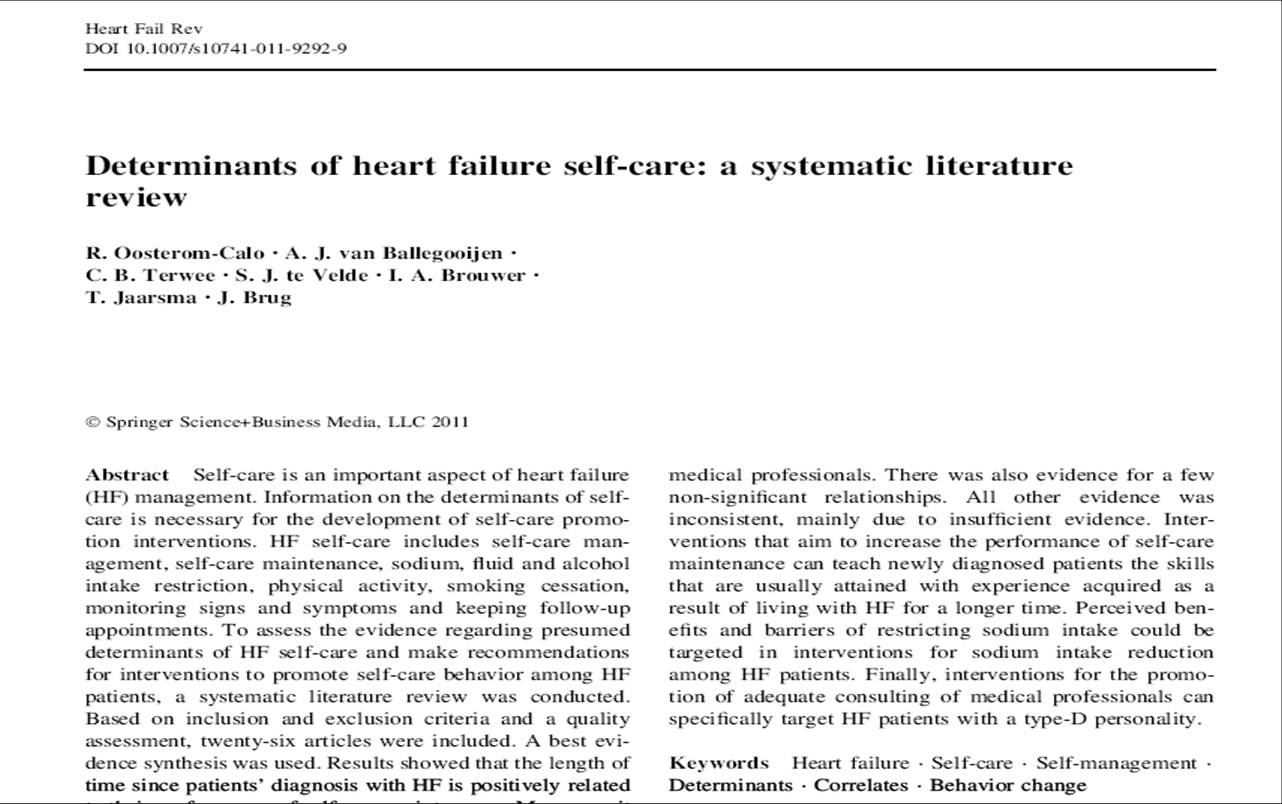
Self-care is an important aspect of heart failure (HF) management. Information on possible determinants of selfcare is needed for the development of self-care promotion interventions. HF self-care includes self-care management, self-care maintenance, sodium, fluid and alcohol intake restriction, physical activity, smoking cessation, monitoring signs and symptoms and keeping follow-up appointments. To assess the evidence regarding presumed determinants of HF self-care in order to make recommendations for interventions to promote self-care behavior among HF patients, a systematic literature review was conducted. This review is now published in the journal Heart Failure Reviews, with Rony Oosterum-Calo as first author. Twenty-six original scientific articles were included in the review. Results showed that  patients’ who were diagnosis with HF longer agi, i.e. with more experience with the disease, were more likley to performe self-care maintenance. Moreover, it was found that HF patients’ perceived benefits and barriers are related to their restriction of sodium intake, and that patients with type-D personality are less likely to consult medical professionals. All other evidence was inconsistent, mainly due to insufficient evidence or lack of studies. Interventions that aim to increase the performance of self-care maintenance can teach newly diagnosed patients the skills that are usually attained with experience acquired as a result of living with HF for a longer time. Perceived benefits and barriers of restricting sodium intake could be targeted in interventions for sodium intake reduction among HF patients. Finally, interventions for the promotion of adequate consulting of medical professionals can specifically target HF patients with a type-D personality.

Thursday, December 8, 2011

Trying to explain educational differences in consumption of sugary drinks

One of the possibly most important correlates and determinants of nutrition behaviour is socio-economic background. Again and again it is found that people from lower socio-economic status, as indicated by level of education, income, job status or other factors, are, for example, more likely to be overweight and eat poorer diets. Such differences are already found among children and adolescents. In a recent paper published in Public Health Nutrition, we explored mediators of gender and educational differences in sugarsweetened soft drinks consumption (SDC) and we investigated whether gender and level of future education moderate the associations of accessibility, modelling, attitudes and preferences with SDC. We were able to use data from 2870 children in 9th and 10th grade from more than thirty secondary schools in Norway.
As expected, girls and pupils planning higher education reported to drink SDC less often than boys and pupils going to higher levels of education. The differences according to future education plans were mediated by accessibility and modelling: thus children who were planning to go to higher education had lower accesibility to sugary drinks and were less likely to be exposed to peer models that drank lots of sugary drinks.

The joint Australian-New Zealand Nutrion Societies meeting

Last week I presented the results of the ENERGY study on childhood overweight and obesity and prevention of childhood overweight and obesity across Europe, at the annual meeting of the Australian and New Zealand nutrition societies. The meeting's theme was 'Lean and Green' with a focus on obesity as well as on sustainable food and nutrition. My keynote presentation was linked to the 'Lean' theme, while Prof. Tim Lang talked about the link with sustainability - via a web-video presentation. The meeting was much like similar meetings in the Netherlands or elsewhere in Europe, with similar presentations, studies and discussions, and even sponsors (e.g. similar to such events in the Netherlands, the Dairy industry was the main sponsor of the meeting).

Monday, November 28, 2011

Visiting the School of Population Health, University of Auckland

On my way to the joint annual meeting of the Australian and New Zealand Nutrition Societies in Quesnstown, New Zealand, together with Professor Kylie Ball from Deakin University, I visited the clinical trial research unit of the School of Population Health of the University of Auckland. We had meetings with the behavioral nutrition and physical activity research leaders of the unit, i.e. Cliona Ni Mhurchu and Ralph Madison, as well as a number of research fellows and PhD students. Kylie and I provided a joint symposium at lunch time.