
Tuesday, November 30, 2010
Tailored health education messages increase attention

Tuesday, November 16, 2010
Preparing a special series on epidemiological modelling to progress obesity research and inform obesity policy.
 On Monday and Tuesday, November 15 and 16 a group of scientists got together in London at the Welcome Trust conference center, guided by the editors of the Lancet, and supported by the National Heart Forum, to prepare a special series in the Lancet journal on the progress in obesity epidemic and policy research enables by the development and use of epidemiological modelling. This special series will be similar to the one on chronic disease that was recently published in the journal.
The authors of the draft papers were there as well as invited reviewers, to present and comment upon the draft papers and discuss the further development of the special series. I was invited to review on of the four papers. Of course, because the papers are still in a preliminary state, no details on the content of the papers can be shared here. But the series will probably make an important contribution to informing clinicians, public health professionals, policy makers, as well as the general public about epidemiological modelling contributing to better evidence-based obesity policies.
Thursday, November 11, 2010
Experiencing the new Nordic Diet at Noma restaurant
A few years ago, Dr. Elling Bere of Agder University in Kristiansand, Norway and myself published a paper in Public Health Nutrition, arguing in favour of regionally appropriate and sustainable health promoting diets ‘diets’.


We argued that because most of the key determinants of the world’s burden of disease are diet-related, the promotion of healthful diets is important for population health worldwide. Furthermore, we argued that changes in health promoting eating habits may also contribute to preservation of the environment. For that purpose, we believed that the translation of health-promoting dietary recommendations into practical recommendations for healthful eating should be more tailored to regional circumstances. This will promote population health as well as help preserve cultural diversity in eating habits and contribute to more environmentally friendly eating. We described a possible regional ‘Nordic’ diet, mimicking the Mediterranean diet to some extent, as an example of such regionally appropriate health promoting diets based on food stuffs readily available and culturally embedded in the Nordic countries of Europe.
The ‘Nordic Diet’ has received quite some attention in recent years and a Danish research project was started. Arguably the best advocate of Nordic eating is the famous Noma restaurant. Noma is a two Michelin star restaurant run by chef René Redzepi in Copenhagen, Denmark. The name is an acronym of the two Danish words "nordisk" (Nordic) and "mad" (food), and the restaurant is known for its reinvention and interpretation of the Nordic Cuisine. In 2010, it was ranked as the Best Restaurant in the World.

Yesterday I was finally able to enjoy the Nordic diet in the very best possible way. With foods like fried reindeer moss, live shrimp (see picture!), goat butter, pine needle desert, wild duck, steamed oyster and much more, I had the best eating experience ever.
Thursday, November 4, 2010
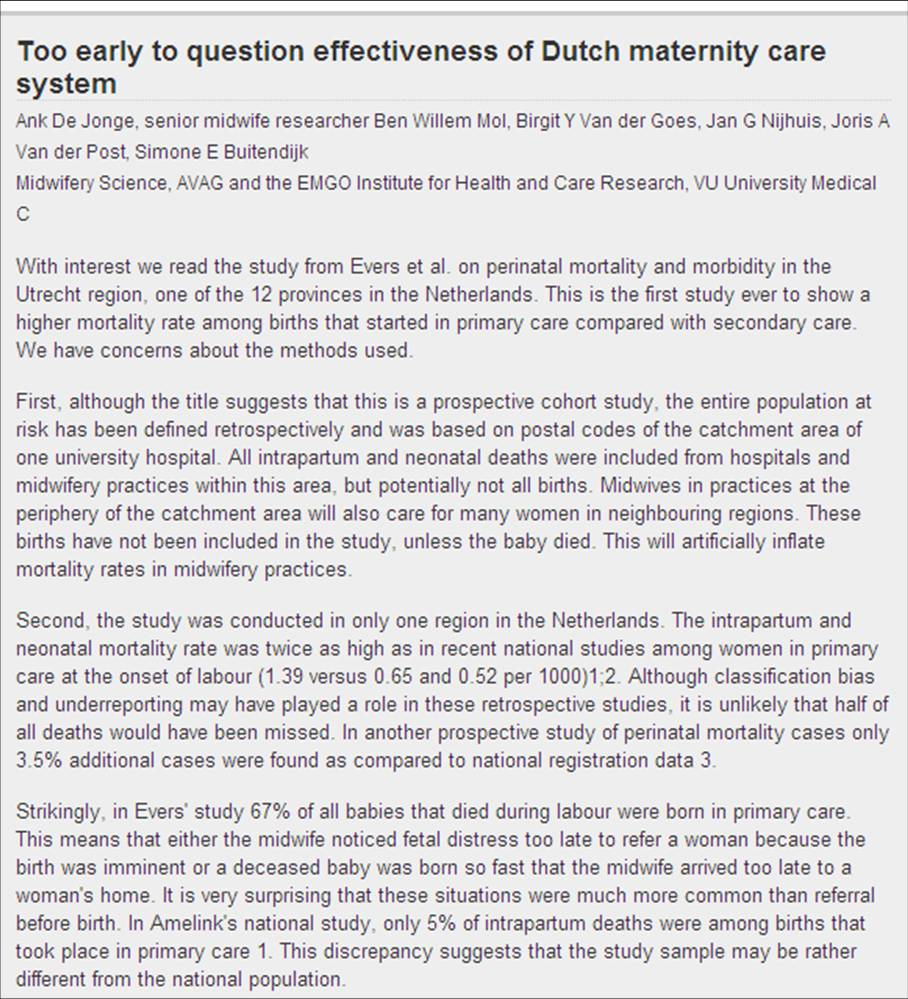
EMGO+ Midwifery researchers respond in BMJ to a paper in that journal questionning the Dutch maternity care system
 |
| Click here for the full rapid response |
Dr. Ank de Jonge from the EMGO Institute for Health and Care Research and colleagues wrote a rapid response in the British Medical Journal to the paper by Evers et al. in the BMJ on perinatal mortality and morbidity in the Utrecht Netherlands
Wednesday, November 3, 2010
A writing workshop to report the first results of the ENERGY project.
 From 3 to 5 November, representatives of the EuropeaN Energy balance Research to prevent excessive weight Gain among Youth (ENERGY) project meet in Amsterdam for a ‘writing workshop’. A group of researchers from
Monday, October 18, 2010
What social networks promote the spread of behavior change?
 In the September 3 issue of Science Magazine a very interesting study by Demon Sentola provides supportive experimental evidence for why behavior change may be more likely in community-based approaches than in more linear health education settings. The paper reports on 6 experiments that show that behavior change spreads more quickly, more thoroughly and is adopted more strongly in social networks with more clustering, i.e. with many interlinking ties between individuals, than in more random social networks with few casual ties between individuals. The latter social network is associated with quicker spread of infections and is regarded as more effective for spreading knowledge across societies. But these studies indicate that for behavior change, many interlinked direct social contacts may be needed to reinforce behavior changes.
Sunday, October 17, 2010
The cost-effectiveness of health education and health promotion interventions
True evidence-based behavioral nutrition and physical activity interventions are hard to ac
 complish. The health effects of such interventions are often only seen in the long run; increasing physical activity or healthful dietary changes will not immediately reduce the risks for heart disease or diabetes. It maye take years before such healthful behavior changes show in morbidity or mortality statistics. Evaluation of behavioral nutrition and physical activity is therefore mostly beased on analyses of changes in these behaviors, not on changes in actual health or disease. Economic evaluations, i.e. assessing the cost-effectiveness of behavior change interventions is therefore hardly ever done.
However, in recent years, evaluation of health effects and of the cost-effectiveness of behavior change interventions is more often attempted, by using epidemiological modelling. In such model-based evaluations the behavior change effects, e.g. the effects of the intervention in terms of minutes of extra physical activity per week, or extra servings of fruit and vegetables per day, is translated into expected health effects by means of epidemiological models that are based on the best available evidence on how such changes in behavior predict changes in health and disease in the (sometimes many) years to come.
 In recent weeks two papers appeared that attempted to assess the cost-effectiveness of behavioral nutrition and physical activity interventions. The first study, by Dr. Saskia te Velde et al, published in Economics and Human Biology presents the assessements of long-term health effects and cost-effectivess of the Pro Children intervention. Pro Children was a European Commission funded project aiming to increase fruit and vegetable intakes among school children in Europe. Te Velde et al presented the positive effect on behavior change in an earlier paper in the British Journal of Nutrition, and now present clear indications of the cost-effectivenes of this fruit and vegetable promotion scheme based on an established epidemiological model. The second paper by Dr. Van der Keulen et al. (Hilde vander Keulen defended her doctoral thesis succesfully and thus got her PhD last Friday)
, published in the International Journal of Behavioral Nutrition and Physical Activity assessed the cost-effectiveness of the Vitalum interventions, a computer-tailored health education intervention, a motivational interviewing intervention, and a combination of both, to promote physical activity and fruit and vegetable intakes among older adults. This study also provides clear indications that these interventions are cost-effective, with the best economic evidence for the computer-tailored intervention.
These studies contribute to better evidence-based health education and health promotion and do indicate that such interventions can be cost-effective.
Subscribe to:
Posts (Atom)